‘Ring’ Pilgrims: On the Horns of a Devotion

Arve Dinda/Bayreuther Festspiele, via EPA
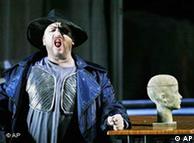
Richard Wagner’s “Ring” cycle (a scene during the 2004 Bayreuth Festival) exerts a strong influence over its fans’ choice of headgear.
By CHARLES McGRATH
Published: July 8, 2007
A CERTAIN class of operagoers, sometimes known as Ringnuts or Wagnolaters, is to classical music what Deadheads or Phish followers are to rock — except that they’re more apt to stay in four-star hotels and sip white wine than to sleep in their vans and pass the bong.

Wagner Society
Metropolitan Opera orchestra members brandished their Wagner tubas in 1993.
They obsess about Wagner’s “Ring” cycle and will travel anywhere to see a production, but especially to Bayreuth, in Germany, home of the theater Wagner designed for himself. You see them every five or six years in New York, Seattle, Chicago, Berlin. They can quote extensively from the operas — not just “Ho-jo-to-ho!” but whole chunks of actual German — and will debate for hours the virtues of, say, Patrice Chéreau’s 1976 centennial production, controversially set at a hydroelectric power dam and featuring gods in business suits, as compared with Georg Solti’s 1983 version, which had the standard spears and Viking helmets.
Ringnuts have been known to wear plastic versions of those helmets while standing in line outside the opera house. Mary Brazeau, the executive assistant to the director of the Seattle Opera, also recalls a fan, a borax miner from Death Valley, who used to attend the Seattle “Ring” productions while for some reason wearing two suits at the same time. But true Wagnolaters are more easily identified by a certain dreaminess of expression, a result of musical transport.
The record holder is probably Sherwin Sloan, a retired ophthalmologist from Los Angeles, who has attended 82 “Rings” so far and has tickets to Bayreuth in August. Recalling his first “Ring,” at Seattle in 1975, he said recently: “I went by myself, and I came back just mesmerized. After two or three days my kids came up to me and said: ‘Dad, there’s something wrong. You’ve been a zombie.’ ”
Starting next weekend, “Ring” lovers from all over will be flocking to the Lincoln Center Festival, where the Kirov Opera is landing with a production that has been on the road, on and off, for four years. There were earlier stops in Tokyo; Seoul, South Korea; Baden-Baden, Germany; Southern California; and Wales, and the show will eventually move on to Beijing. Along the way the production has gathered mixed reviews, though not as mixed as Mark Twain’s verdict after hearing the “Ring” at Bayreuth in 1876, when he famously said that Wagner’s music “isn’t as bad as it sounds.”
Depending on which critic you believe, or perhaps on which performance you happened to attend, the Kirov “Ring,” under the conductor and impresario Valery Gergiev and featuring an enormous, assembly-line cast, is either ragged or sublime. Either the Russians have no feel for Wagner or else they bring to him a dramatic and passionate intensity. George Tsypin’s sets are sculptural and postmodern, or they put you in mind of Al Capp’s shmoos.
All the same, a complete “Ring” doesn’t get put on every day. The Lincoln Center Festival is presenting the Kirov production twice, over two consecutive weekends (Friday and Saturday, and July 20 and 21) and also, as Wagner preferred, on four consecutive evenings (July 16, 17, 18 and 19), and, as always whenever a “Ring” takes place, the clan will gather.
After being thwarted in two previous attempts to see the Kirov production, Philip Chevron, the lead guitarist of the Irish punk band the Pogues, is flying from Dublin. (Mr. Chevron is a little unusual among Wagner fans in that he has no use for CDs or DVDs. “Nothing on earth would persuade me to listen to a recording of ‘Siegfried’ or ‘Die Walküre,’ even a purportedly classic recording,” he wrote in an e-mail message. “Wagner is theater music and needs to be experienced in the theater as it was intended.”)
Dan Mozes, a retired executive, is coming from Israel, where Wagner’s music is unofficially banned. “To me this is most ridiculous,” he said in a telephone interview. “Why do we ban Wagner and perform the essence of fascist music, which is the ‘Carmina Burana,’ by Carl Orff? And the fact that Wagner was anti-Semitic is not sufficient. The Nazis also liked Chopin, Brahms, Beethoven. There’s no end to it.”
Yoichi Okuda, an information technologies executive and confessed “ ‘Ring’ maniac” from Tokyo, saw the Kirov “Ring” in California last year. He’s going to see it again in New York, he said by e-mail, because the tickets are much cheaper than in Tokyo. He added that he loved the Kirov orchestra and cast but didn’t understand all the production details, especially the decision to outfit the Valkyries in “caps like Indians.”
Still other fans are coming from Sweden, Bavaria, the Netherlands and Colombia, and there is a huge medical contingent, including, along with Dr. Sloan, Steinn Jonsson, a professor of medicine in Reykjavik, Iceland, and Ruy Lourenço, the former dean of the New Jersey Medical School. But Alex Kagan, a psychiatrist in Tallahassee, Fla., who once wrote a scholarly paper relating “Das Rheingold” to theories of neurotic character structure, cautioned against drawing too many conclusions about the Wagner-medico connection. “I think it’s probably just that physicians are the only ones who can afford the tickets,” he said.